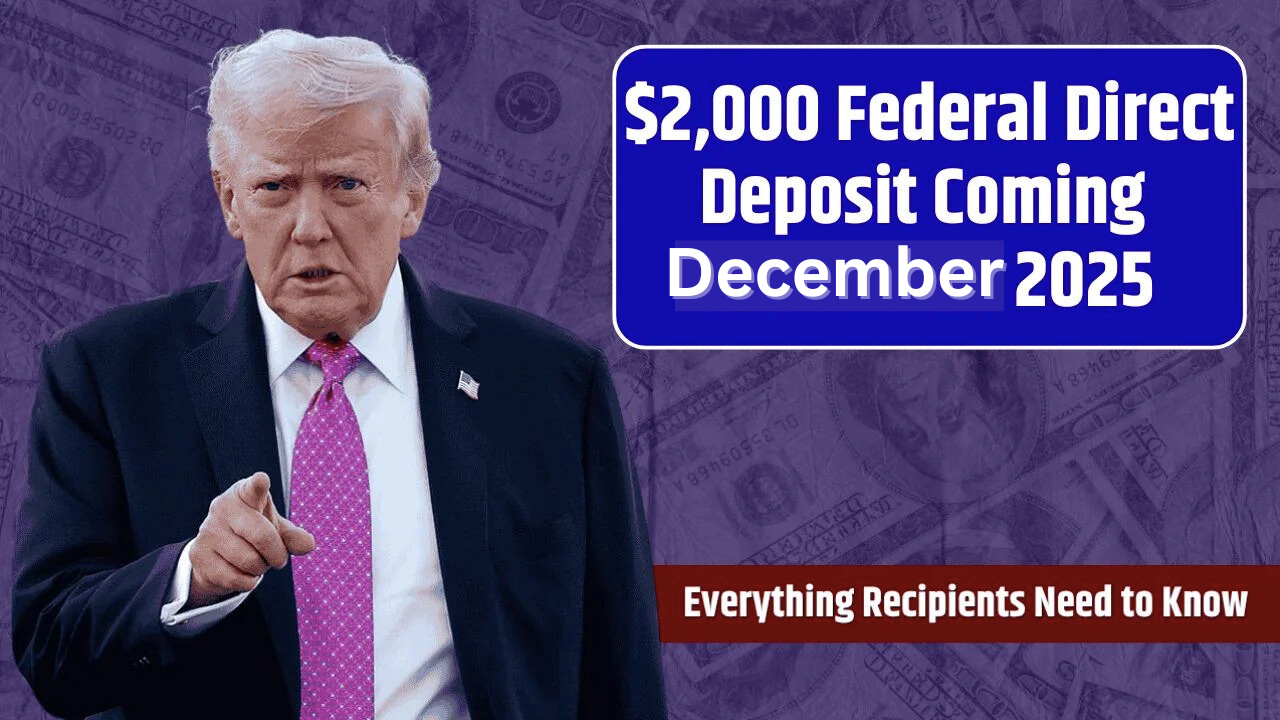
Federal $2,000 Deposit Arriving December 2025: Recently, there has been a lot of buzz online and in the media that the U.S. federal government—through the Internal Revenue Service (IRS) or other agencies—is preparing to send direct deposits of $2,000 to many Americans in December 2025. This speculation is largely linked to a new proposal by Donald J. Trump, who has proposed a so-called “tariff dividend”: a one-time payment to eligible citizens using revenue generated from tariffs (taxes on imported goods).
For many families still feeling financial pressure due to rising housing, food, or energy costs, the idea of an extra $2,000 makes sense. It’s easy to see why such news spreads so quickly online, as people expect both year-end relief and some financial support.
What do official sources actually say?
Here’s a reality check from an official and reliable source:
- So far, no U.S. federal government agency—neither the IRS, the U.S. Department of the Treasury, nor the Social Security Administration (SSA)—has confirmed any plans to send a new $2,000 stimulus-style payment in December 2025.
- There is no law authorizing such payments, and the U.S. Congress has not passed a bill.
- Thus, any “payment schedule,” “direct deposit date,” or “automatic check” being shared on social media or through viral articles is unverified and speculative, not based on actual government action.
- In fact, official statements warn that many of these claims are fueling a wave of scams: asking for bank or personal information; phishing links; The so-called “Qualify Now” forms — none of which are legitimate.
Why the Confusion—and Why Rumors Persist
There are several reasons why the $2,000-deposit story remains alive despite the lack of formal approval:
- The memory of pandemic-era stimulus payments (e.g., those sent in 2020–2021) gives people hope for similar relief again. That nostalgia creates ripe ground for rumors.
- The “tariff dividend” proposal—which political figures have publicly discussed—offers a plausible way to deliver payments, creating the impression that “it’s coming soon.”
- There is a high demand for financial relief, especially among low- and middle-income workers, retirees, benefit recipients (SSA, SSI), and families—so many people pay attention to even small signals and cling to hope.
Unfortunately, this combination encourages scammers to take advantage of the noise: they spread misinformation or phishing schemes disguised as “official announcements” to trick people into sharing sensitive data.
What Beneficiaries Should Actually Do—and What Not to Do
If you’re wondering what to do in light of these rumors, here’s a practical guide:
- Don’t budget assuming a $2,000 deposit is coming. Since nothing has been approved or scheduled, consider any deposit news to be guesswork until an official announcement.
- Keep your tax filing, banking, and mailing information updated with the IRS/SSA. If a payment program is approved in the future, accurate information will help ensure you don’t miss anything.
- Verify information only from official sources. Use IRS.gov, Treasury.gov, SSA.gov, or the official press release page—not social media, WhatsApp forwards, or viral websites.
- Be suspicious of any unsolicited messages or emails. The IRS will never ask for bank details or fees to release funds. If you receive messages promising a “fast-track release” or asking for an early payment, consider them a scam.
If you receive regular federal benefits (Social Security, SSI, VA, etc.), stay informed about your regular payment schedule, but don’t expect extra or bonus payments associated with rumored $2,000 deposits.
How a $2,000 deposit could actually happen—and why it’s not certain
For the $2,000 federal payment to actually happen, several things must happen:
- A proposal (e.g., a tariff dividend plan or similar rebate bill) must be formally introduced in Congress.
- It must pass both the House and Senate, and then be signed into law by the President.
- The government (Treasury/IRS/SSA) must create administrative systems: eligibility rules, bank-account verification, payment scheduling, etc.
- Finally—and only then—can funds be disbursed and direct deposits or checks issued.
Right now, we’re stuck at Step Zero. No bill, no legislation, no funding, no system. Until that changes—if it ever does—the $2,000 deposit is just a myth.
Analysts also warn that large-scale, one-size-fits-all payments may not be appropriate: sending $2,000 to every eligible American would cost hundreds of billions of dollars, raising concerns about the country’s debt, inflation, and long-term economic impact.
What this means for the average person—in simple terms.
Think of the $2,000 payment as a birthday wish many people hope will come true—but no one has sent the invitations yet. The money hasn’t been approved. Delivery drivers don’t know when to arrive. And there’s a good chance the celebration will never happen.
If you’re managing monthly bills, groceries, rent or mortgage, or other expenses—it’s wise to manage them as if nothing extra is coming in. In the meantime, protect yourself from scammers by staying vigilant and relying only on official communications for financial updates.
If you’d like—I can also tell you how to spot scams (common red flags, common phishing tactics, etc.) associated with these $2,000-payment rumors. This is often helpful for those worried about fake “IRS checks.”
Frequently Asked Questions (FAQs)
Question: Has Congress approved a $2,000 federal deposit?
Answer: No. As of now, Congress has not passed any legislation approving a $2,000 stimulus or “tariff dividend” payment. This proposal remains political talk, not law.
Question: Has the IRS announced a payment schedule or direct deposit for December 2025?
Answer: No. The IRS—along with the Treasury and Social Security Administration—has not released any official announcement, letter, or portal indicating that such a payment is coming.
Question: Who would qualify if the payment is ever approved?
Answer: Proposals that have been publicly discussed suggest that benefits could be available to low- and moderate-income individuals, regular federal benefit recipients (such as SSA, SSI, or VA beneficiaries), or taxpayers below a certain income limit. But because no legislation has been passed, eligibility rules are still speculative.
Question: Do I have to apply to receive a payment?
Answer: Under the current proposal, payments would likely be automatic—based on recent tax filings or the federal benefit database. But again: nothing is official, so no application is available.
Question: Are social media posts claiming a “guaranteed” $2,000 deposit real?
Answer: Almost certainly not. Many such posts are misleading or part of scams. Reliable sources are only official government websites (IRS, Treasury, SSA) or reputable news organizations.
Question: What happens if the plan doesn’t pass Congress?
Answer: Then no payments will be issued—and all current messages about deposits will remain rumors. Beneficiaries will continue to receive their regular payments (tax refunds, Social Security, etc.), but will not receive anything extra.
Final Thoughts
It’s normal to hope for more help—a $2,000 payment could make a real difference for many people. But until December 2025, this will remain a ‘what if’, not a reality. Until Congress takes action and government agencies approve and implement the plan, the “federal $2,000 deposit” should be considered a mere estimate—not a financial lifeline.